
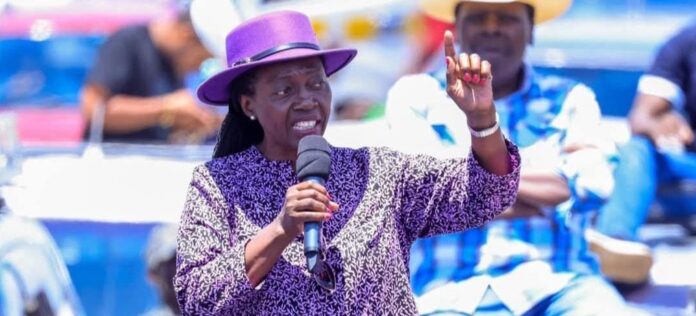
People’s Liberation Party (PLP) leader Martha Karua has used the first anniversary of Raila Odinga’s death to deliver a political message centred on justice, national unity and better living conditions for Kenyans. Speaking at Migwena Cultural Grounds in Bondo, Siaya County, on Thursday, October 15, 2026, Karua invoked the popular “Wantam” slogan, declaring that Raila’s vision would endure beyond the leaders who occupy positions of power. Her remarks added a political dimension to the commemoration as questions continue to emerge over the future of the Orange Democratic Movement (ODM) and the late opposition leader’s legacy.
Highlights
- Martha Karua invoked the “Wantam” slogan during Raila Odinga’s first death anniversary.
- She said Raila’s vision focused on justice, food security and national unity.
- Karua was Raila’s running mate in the 2022 presidential election.
- Winnie Odinga and Raila Junior also addressed concerns about Kenya’s economy and ODM’s future.
- The remarks come amid political debate over Raila’s legacy ahead of the 2027 General Election.
Main Story
Karua Uses Raila’s Memorial to Deliver Political Message
Martha Karua has declared that Raila Odinga’s political vision will remain relevant regardless of changes in leadership, using the late former Prime Minister’s first death anniversary to highlight issues she believes defined his ambitions for Kenya.
Addressing mourners at Migwena Cultural Grounds in Bondo, Karua began her speech with chants celebrating Bondo and Kenya before turning to the values she associated with Raila’s political journey.
The PLP leader, who served as Raila’s running mate in the 2022 presidential election, said his vision was rooted in respect for citizens’ rights, access to food and a more united country.
Her address stood out for its reference to “Wantam”, a political slogan associated with calls for President William Ruto to serve only one term.
‘Raila’s Dream Was for Every Kenyan’
Speaking in Kiswahili, Karua said Raila wanted every Kenyan to have their rights respected and no citizen to go hungry.
She stressed that political leaders would eventually leave office, but the ideals associated with Raila’s vision would continue to matter.
Her message placed economic welfare and constitutional rights at the centre of the anniversary discussion, connecting Raila’s legacy to issues that remain prominent in Kenya’s public debate.
For Karua, the former Prime Minister’s contribution should not be measured solely by the positions he held or the political alliances he formed, but also by the aspirations he championed for ordinary citizens.
What ‘Wantam’ Means in the Political Debate
Karua’s use of “Wantam” introduced a contemporary political reference into an event primarily intended to remember Raila’s life and contribution to the country.
The slogan is associated with opposition to a second presidential term for Ruto and has featured in political conversations ahead of the 2027 General Election.
By connecting the slogan to Raila’s ideals, Karua framed the commemoration around questions of accountability, leadership and the future direction of the country.
Her remarks also come amid wider discussions about how Raila’s political supporters will interpret his legacy and the role ODM will play in the next electoral cycle.
Winnie Odinga and Raila Junior Raise Concerns
Raila’s children, Winnie Odinga and Raila Junior, also addressed the gathering, drawing attention to the economic difficulties facing Kenyans and questions surrounding ODM’s political direction.
Their interventions added another dimension to the anniversary, as supporters reflected not only on Raila’s achievements but also on the future of the political movement he led.
The debate over ODM’s direction has become increasingly significant following Raila’s death, with questions about leadership, political partnerships and the party’s long-term identity continuing to attract attention.
Raila’s Legacy Beyond Political Alliances
Raila’s political career spanned decades and included periods of opposition, negotiations with successive administrations and participation in efforts to reform Kenya’s governance structures.
His supporters have long associated his legacy with democratic reform, political inclusion and the pursuit of greater accountability.
Karua’s address sought to keep those themes in focus, arguing that the principles associated with Raila should remain important regardless of who holds public office.
As Kenya approaches the 2027 General Election, the anniversary has become an occasion for reflection on how different political leaders and movements interpret the late former Prime Minister’s ideals.
Ultimately, the significance of Raila’s legacy will depend not only on the tributes delivered in Bondo, but also on how questions of justice, economic security and national unity are addressed in the years ahead.
Raila Odinga’s political journey may have ended, but the questions surrounding his vision remain alive. As Kenya looks towards 2027, will the ideals of justice, food security and national unity become lasting priorities beyond the campaign slogans?

