
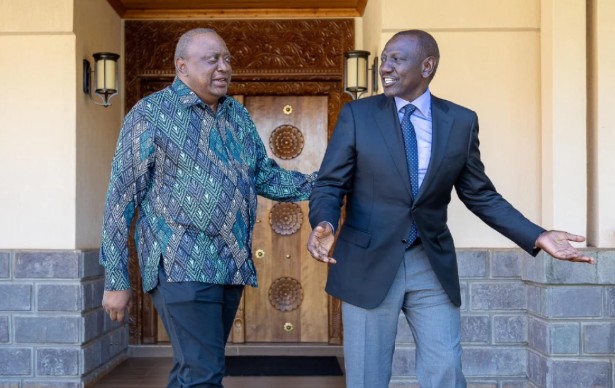
President William Ruto has reignited his political rivalry with former President Uhuru Kenyatta, accusing his former ally of betraying him despite their long-standing political partnership. Speaking in Ziwa, Uasin Gishu County, Ruto also positioned the 2027 General Election as a defining moment for national unity, insisting that Kenya must move away from tribal politics, hatred and division towards a development-driven political agenda.
Highlights
- Ruto accused Uhuru Kenyatta of going back on an alleged political agreement between the two leaders.
- The President recalled supporting Uhuru in the 2013 and 2017 elections.
- Ruto described the 2027 elections as an opportunity to strengthen national unity and end ethnic divisions.
- He defended his administration’s record on education, teacher recruitment and economic recovery.
- The President challenged political leaders to prioritise development plans and policies over ethnic loyalties.
Main Story
Ruto Revives Political Feud With Uhuru Kenyatta
President William Ruto has launched a fresh verbal attack against former President Uhuru Kenyatta, accusing him of political betrayal and questioning his opposition to the current administration.
Addressing residents in Ziwa, Uasin Gishu County, Ruto revisited the political relationship that brought the two leaders together during the Jubilee era before their partnership collapsed ahead of the 2022 General Election.
Ruto recalled supporting Uhuru in the 2013 and 2017 presidential elections, arguing that he had remained loyal to their political arrangement for years.
The President claimed that their understanding was based on an arrangement in which each would serve for two presidential terms. He accused Uhuru of failing to honour that understanding when his own presidential ambitions came into focus.
In his remarks, Ruto used particularly strong language to express his frustration with the former Head of State, accusing him of dishonesty and describing him as a “massive conman.”
He also questioned why Uhuru would oppose his administration after years of political cooperation.
The accusations reflect the continuing fallout between the two leaders, whose relationship deteriorated after Ruto broke ranks with the Uhuru-led political establishment and went on to win the presidency in 2022.
Ruto Defends His Administration’s Record
Beyond the political accusations, Ruto used the address to defend his administration’s performance, particularly in education and economic management.
The President cited the recruitment of 100,000 teachers, the construction of classrooms and changes to university funding as examples of measures he said were intended to improve the country’s education system.
He contrasted these initiatives with what he described as the challenges inherited from the previous administration, including pressure on the economy, public debt and difficulties within the university funding system.
Ruto also claimed that his government had helped revive Kenya’s economy, pointing to the country’s position among Africa’s largest economies.
These remarks formed part of his broader effort to present his administration as focused on delivering development while challenging critics over their own records in government.
President Positions 2027 as a Turning Point for National Unity
Ruto also used the gathering in Uasin Gishu to renew his call for politics that prioritises national interests over ethnic identity.
He argued that the political direction established during the 2022 elections should continue into the next electoral cycle, with leaders judged on their policies, development plans and ability to deliver results.
According to the President, his outreach to communities across the country, including those that did not support him at the ballot, is part of an effort to build a broader national political coalition.
He maintained that the 2027 General Election should bring Kenyans together around a common development agenda rather than deepen divisions along tribal and political lines.
Ruto further called for an end to political hostility, discrimination and divisions that he said have hindered national cohesion.
His message was that Kenya’s political future should be shaped by shared priorities and a collective vision for development.
A Campaign Message Ahead of 2027
The President’s remarks combine a renewed appeal for national unity with sharp criticism of a former political ally, highlighting the competing dynamics shaping Kenya’s political landscape ahead of the next General Election.
While Ruto has framed his message around development and the need to move beyond ethnic divisions, his accusations against Uhuru underscore the unresolved tensions between the two leaders.
As political alignments continue to evolve, the debate over leadership, economic performance and the country’s future direction is expected to remain central to the road towards 2027.
For voters, the key question will be whether political leaders can translate calls for unity and development into tangible improvements in people’s lives.
With the 2027 elections approaching, Kenyans will be watching closely to see whether calls for national unity can rise above political rivalries or whether old disagreements will continue to shape the country’s future.

