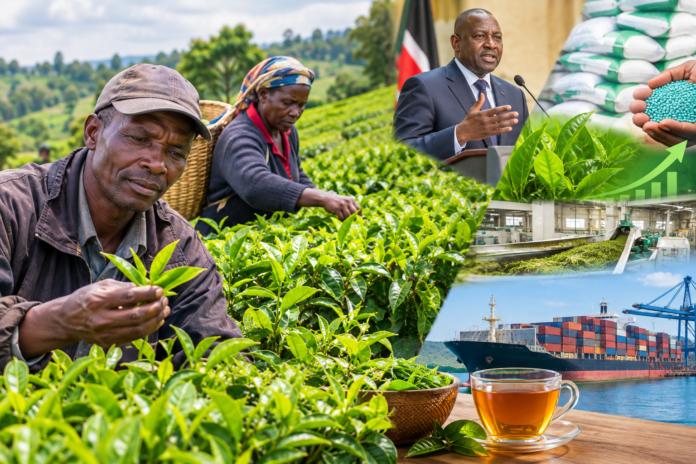
Kenya’s tea industry is producing more and earning billions from exports, but many smallholder farmers say the money is still not reaching their pockets. From Nandi to Kisii, growers are calling for better green-leaf prices as the government pushes reforms aimed at raising farmer earnings to at least Sh100 per kilo by next year.
Highlights
- Some tea farmers say current payments remain insufficient to meet household costs.
- The government wants tea farmers to earn at least Sh100 per kilo by next year.
- More than 650,000 smallholder farmers have received subsidised fertiliser since 2022.
- Kenya’s tea export earnings rose to Sh186.9 billion in 2025.
- Farmers and industry players are pushing for more value addition and better governance.
Main Story
Farmers Say Tea Income Is Still Too Low
For Kennedy Kemboi, who manages a seven-acre tea farm in Baraton, Nandi County, the cost of production remains a major concern.
Kemboi says he is looking forward to receiving subsidised fertiliser from the government to help manage the cost of maintaining his farm.
He currently earns about Sh26 per kilo for his green leaf, a payment he says allows him to pay his workers while leaving some income for his household needs.
But he believes farmers could earn considerably more if the challenges affecting the sector were addressed.
Factory Loans Eat Into Farmers’ Earnings
Kemboi says his factory pays farmers through regular monthly payments as well as the annual bonus.
However, he argues that outstanding factory debt continues to affect what growers ultimately receive.
According to him, his factory is servicing a loan of about Sh1.2 billion, meaning farmers effectively shoulder part of the financial burden.
He believes clearing such debts could give farmers more room to benefit from the proceeds of their produce.
Kisii Farmers Also Raise Concerns
The frustration is echoed in Nyamache, Kisii County, where tea farmer Teresa Moraa says tea earnings remain inadequate for many families.
Moraa says her household depends heavily on tea income but that the money is often insufficient to cover important expenses such as school fees.
She wants factory payments to rise significantly, arguing that farmers deserve a price closer to Sh50 per kilo.
Her concerns highlight the gap between the value generated by Kenya’s tea industry and what many growers feel they receive at farm level.
Government Targets Higher Farmer Payments
Tea remains one of the agricultural sectors targeted for major reforms under President William Ruto’s administration.
The government says the goal is to increase farmer earnings, improve the competitiveness of Kenyan tea and strengthen the industry’s contribution to the economy.
The Tea Board of Kenya has identified several priorities, including increasing production, improving farmer incomes, opening new markets, creating jobs and expanding value addition.
The government is targeting payments of at least Sh100 per kilo by next year.
Officials say reaching that figure will depend on improving tea quality, cutting production expenses, increasing value addition and creating more competitive ways of selling Kenyan tea.
Production and Export Earnings Rise
According to Tea Board of Kenya figures cited by industry officials, the average green-leaf payment increased from about Sh35 per kilo in 2021 to Sh64 in 2024 before settling at Sh56 in 2025.
Tea production also grew from approximately 537 million kilogrammes in 2021 to 598 million kilogrammes in 2024, before recording about 550 million kilogrammes in 2025.
Meanwhile, export earnings increased from Sh136.5 billion in 2021 to Sh181.6 billion in 2024 and approximately Sh186.9 billion in 2025.
Despite those gains, the challenge remains ensuring that smallholder farmers receive a larger share of the value generated by the industry.
Subsidised Fertiliser Among Government Measures
One of the government’s major interventions has been subsidised fertiliser.
Since 2022, more than 650,000 smallholder tea farmers have reportedly received about 290,000 tonnes of subsidised fertiliser.
The government has also invested Sh850 million in upgrading machinery and equipment at 17 smallholder tea factories.
Counties including Kericho, Nyeri, Bomet, Nandi, Murang’a, Nakuru, Trans Nzoia, Nyamira, Tharaka Nithi and Kirinyaga have benefited from the factory modernisation programme.
Other measures include tax changes aimed at reducing the cost of tea packaging and encouraging local value addition.
The government has also provided Ketepa with a Sh100 million grant to establish a common-user facility designed to support value addition.
Kenya Wants to Sell More Than Bulk Tea
Agriculture Cabinet Secretary Mutahi Kagwe has argued that Kenya needs to reduce its dependence on traditional tea markets while pursuing new destinations for its products.
The government is also focusing on product innovation, quality, safety, traceability and climate resilience.
The push for diversification is partly driven by the fact that much of Kenya’s tea is exported in bulk, meaning other countries and companies can capture additional value through blending, branding, packaging and retailing.
Industry players say Kenya and other African tea-producing countries need to move further up the value chain if farmers are to benefit more from the global tea business.
Governance Remains a Major Concern
Farmers have also raised questions about the management of tea companies.
Charles Otwori, a farmer and chairman of the Nyamira Professionals Association, says growers remain unhappy with their earnings and have concerns about the governance of companies associated with the Kenya Tea Development Agency.
KTDA manages 54 tea companies in which smallholder farmers are shareholders.
Otwori argues that stronger governance and more farmer-focused leadership could help address some of the industry’s longstanding problems.
The Bigger Challenge: Who Captures the Value?
The tea sector faces a range of challenges, including low farm-gate prices, alleged manipulation of weights, tea hawking, high production costs, inconsistent international prices and declining quality.
Kenyan tea also faces stiff competition in international markets, while the country remains heavily dependent on a limited number of export destinations.
At the African Tea Convention in Nairobi, East Africa Tea Trade Association chairman Robert Koech argued that the industry needs to rethink how it measures success.
The future, he said, lies increasingly in brands, specialised tea products, extracts, ready-to-drink beverages, traceability and sustainability.
Industry experts say African countries have the farmers, raw materials, manufacturing capacity and growing entrepreneurial talent needed to capture a larger share of the global tea business.
Will Farmers Finally Earn More?
Kenya remains one of the world’s major tea producers, with its black CTC tea valued globally for its strength, colour and brightness.
But increased production and rising export earnings do not automatically translate into better livelihoods for growers.
For farmers such as Kemboi and Moraa, the real measure of reform will be much simpler: how much money remains in their pockets after the tea is harvested and sold.
If the government’s reforms succeed, the next chapter of Kenya’s tea story could be less about producing more tea and more about ensuring that the people who grow it receive a fairer share of its value.
For Kenya’s tea farmers, the real success of reform will not be measured by how much tea the country exports, but by how much of that value finally finds its way back to the hands that grow it.