
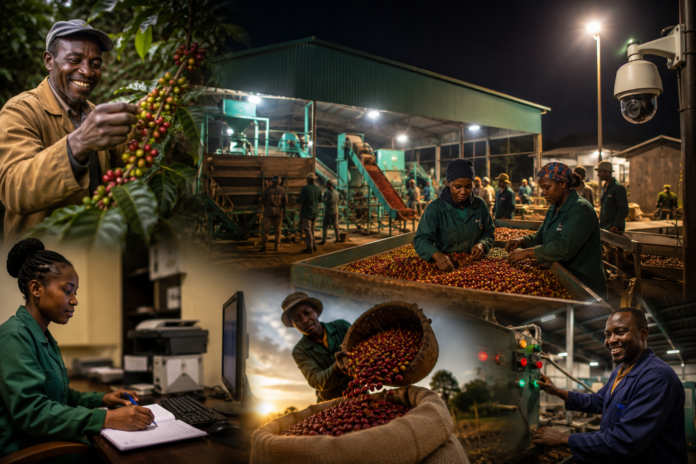
For years, darkness dictated how work was done at Sorwot Farmers Cooperative Society in Kericho County. Coffee processing had to stop before nightfall, security remained a concern and office work was limited by the lack of power. Today, electricity has changed that story, allowing the society to process more coffee, improve quality, strengthen security, digitise its records and create more opportunities for workers and farmers.
Highlights
- Electricity has allowed Sorwot FCS to extend coffee processing into the night.
- Coffee quality and volumes have improved since the society gained reliable power.
- CCTV, security lighting and digital records have strengthened operations.
- Workers are earning more through longer hours and overtime opportunities.
- The society is attracting recognition from buyers and coffee competitions.
Main Story
From Darkness to a New Beginning
For the Sorwot farming community, electricity has become more than just a source of light. It has transformed how one of Kericho’s coffee societies operates and opened the door to new possibilities for farmers and workers.
Paul Kosgei, chairman of Sorwot Farmers Cooperative Society, recalls a time when the area had gone for decades without electricity. The lack of power affected almost every part of the society’s operations, from coffee processing and record keeping to security.
Previously, coffee processing had to end before darkness set in, meaning the factory could close as early as 6 p.m. For farmers, this created a major challenge because freshly harvested coffee needs to be processed promptly to preserve its quality.
The arrival of electricity has now changed that routine.
Better Coffee, More Production
With power available, Sorwot can continue pulping and sorting coffee well into the night. Machine operator Emmanuel Cheruiyot says factory operations can now run until around midnight, a major improvement from the days when workers depended on paraffin lamps and had to shut down machinery early.
Clerk Fancy Chematich says the sorting section has also benefited significantly. Workers who previously left at about 5:30 p.m. can now continue working later, increasing productivity while creating opportunities for overtime.
The increased working hours have coincided with rising coffee volumes. The society handled about 1.6 million kilos of coffee during the previous season and expects production to rise further.
For farmers, the biggest gain is not simply the amount of coffee processed but the improvement in how quickly it moves through the system.
Kiprotich Lang’at, a coffee farmer, says electricity has made it possible to process harvested coffee even after nightfall. Previously, coffee that arrived late could be left until the following day, a delay that could affect its quality and weight.
Faster processing means farmers have a better chance of delivering coffee that meets buyers’ expectations, potentially improving the value of their produce.
Security Gets a Major Boost
Electricity has also brought a stronger sense of security to Sorwot.
The installation of security lights and CCTV cameras means coffee deliveries can be monitored, including the movement of produce within the society. This has helped address concerns over theft and made farmers more confident about bringing their coffee to the facility.
Flora Maritim, who works at Sorwot FCS, says the improved lighting has made night operations safer for employees handling coffee.
Before electricity, working after dark could expose workers to accidents and insecurity. Today, lighting allows them to move around the facility with greater confidence while CCTV provides an additional layer of protection.
From Manual Records to Digital Tracking
The transformation has not been limited to the factory floor.
Kosgei says the society has moved from analogue record keeping to digital systems, making it easier to monitor farmers and their deliveries.
He says he can now track individual farmers’ coffee volumes using their membership numbers, giving the society greater visibility over how much each farmer has delivered.
Electricity has also made everyday office tasks easier. According to Maritim, staff can now print and photocopy documents at the society, charge phones and carry out other administrative duties without travelling elsewhere to access basic services.
Lower Costs and More Jobs
The shift from diesel-powered generators to electricity has also helped reduce the cost of running the coffee processing operation.
For a society handling growing volumes, lower energy costs can make a significant difference, while longer operating hours allow the facility to handle more coffee in a day.
The expansion in activity is already creating employment opportunities.
As more coffee comes in and working hours increase, more people are needed to sort, process and handle the crop. For workers such as Chematich, the longer hours have also opened up opportunities to earn overtime.
Maritim says the increased flow of coffee is benefiting families in the surrounding community as more people find opportunities to earn a living from the expanding operations.
Sorwot Steps Onto the Bigger Stage
The improvements are also beginning to change how Sorwot is viewed beyond the local farming community.
Kosgei says improved coffee quality has helped put the society on the map, with Sorwot receiving invitations to participate in competitions and attracting recognition from buyers, including buyers from South Korea.
For a society that once struggled to operate after dark, the progress represents a significant shift.
The leadership now hopes to take the factory even further, with the long-term ambition of operating continuously for 24 hours when production levels and demand allow.
A Brighter Future for Farmers
For the farmers and workers at Sorwot, electricity has become a foundation for growth rather than simply a utility.
Kosgei says the society is entering every season with greater confidence as production and quality continue to improve. He credits the government, including President William Ruto, for supporting the electrification project and says the change has brought renewed optimism to the coffee-growing community.
The story of Sorwot shows how access to basic infrastructure can have a ripple effect across an entire agricultural value chain from the farmer delivering coffee to the worker processing it and the buyer receiving the final product.
At Sorwot, the lights have come on and for farmers who once had to race against darkness, the future now looks brighter than ever.

