
US President Donald Trump has signalled plans to reduce the scale of joint military exercises with South Korea, arguing that the drills are expensive and send an unnecessarily hostile message to North Korea. The move has raised fresh questions about Washington’s military commitment to Seoul, even as Pyongyang continues to develop its missile and nuclear capabilities.
Highlights
- Trump says the US should substantially reduce joint drills with South Korea.
- South Korea says the scheduled exercises will continue.
- Trump pointed to his relationship with North Korean leader Kim Jong Un.
- Experts warn that reducing the drills could weaken military readiness and deterrence.
- North Korea has recently carried out ballistic missile tests.
Main Story
Trump Questions the Value of Joint Drills
President Donald Trump has called for a significant reduction in US-South Korea military exercises, arguing that the training comes at a high financial cost while potentially sending the wrong message to North Korea.
Trump also linked his position to his relationship with North Korean leader Kim Jong Un, with whom he has previously held high-profile diplomatic meetings.
The US president suggested that scaling down the exercises could help create a less confrontational atmosphere around the Korean Peninsula.
Despite Trump’s comments, Seoul has indicated that the planned military drills will go ahead.
The annual Ulchi Freedom Shield exercise was scheduled to begin on Monday and run for 11 days. Military officials had previously said the training would remain broadly similar in size to previous years, involving approximately 18,000 South Korean troops.
The United States has around 28,500 military personnel stationed in South Korea as part of its long-standing security commitment to the country.
Concerns Over Military Readiness
Trump’s proposal has triggered concern among defence experts who argue that joint exercises play an important role in ensuring that American and South Korean forces can operate effectively together during a crisis.
Leif-Eric Easley, a professor at Ewha University in Seoul, warned that cutting back the exercises could affect coordination between the two militaries and weaken deterrence in the region.
He also questioned whether the financial savings would be significant enough to justify the potential security risks.
North Korea Continues Missile Activity
The debate comes at a sensitive time, with North Korea continuing to expand its missile and nuclear programmes.
Pyongyang has carried out several ballistic missile launches this month, despite international restrictions. North Korea’s foreign ministry has also condemned the US-South Korea exercises, describing them as preparation for an offensive.
The latest drills come against the backdrop of growing concerns over North Korea’s military cooperation with Russia, including the deployment of North Korean troops to support Moscow’s war in Ukraine.
US military officials say their training takes such developments into account.
Trump Also Raises Iran Issue
In his remarks, Trump unexpectedly brought South Korea’s position on the conflict involving Iran into the discussion.
He said he had recently asked South Korean President Lee Jae-myung whether Seoul wanted to support US efforts aimed at denuclearising Iran, but claimed South Korea declined.
The comment appears to reflect broader frustration Trump has expressed toward allies that have been reluctant to make direct military or logistical contributions to the US campaign against Iran.
Kim-Trump Relationship Back in Focus
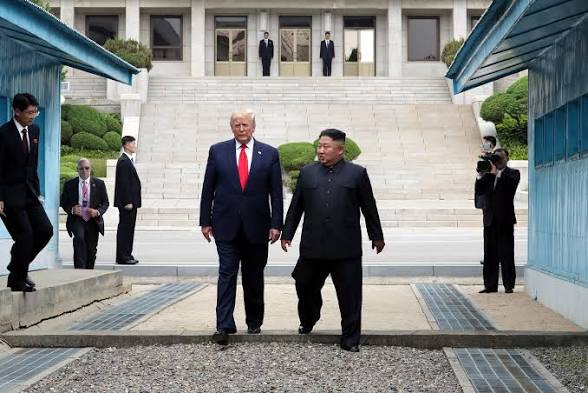
Trump’s latest remarks came shortly after he shared an old photograph of himself with Kim Jong Un from their 2019 meeting, describing the pair as having been good friends.
Their diplomacy attracted global attention during Trump’s first presidency, including Trump’s historic visit to North Korea in 2019.
Although negotiations ultimately failed to produce a lasting nuclear agreement, Trump’s latest comments suggest he remains interested in reopening some form of engagement with Pyongyang.
For South Korea, however, the message is complicated.
A renewed Trump-Kim dialogue could offer an opportunity to reduce tensions on the peninsula. At the same time, any reduction in US military exercises could raise concerns in Seoul about whether Washington’s security commitment is becoming less predictable.
Trump’s proposed changes place the US-South Korea alliance at a delicate point.
Washington wants to maintain pressure on North Korea while keeping diplomatic channels open, whereas Seoul remains heavily dependent on the alliance for deterrence against Pyongyang.
As Trump looks to balance diplomacy, military spending and America’s alliances, the bigger question may be whether fewer exercises can bring North Korea closer to the negotiating table without making South Korea feel less secure.

