
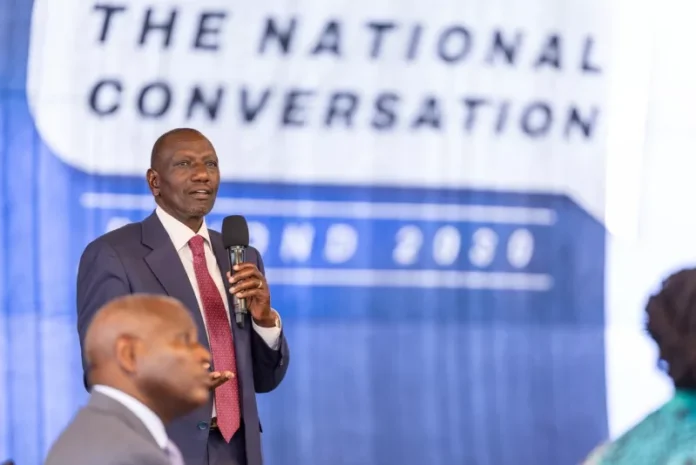
President William Ruto has officially launched the Beyond 2030 National Conversation, bringing together Kenyans from all 47 counties, political leaders, youth representatives, faith groups and government officials to help shape the country’s long-term development agenda.
The initiative seeks to create a people-driven roadmap that will guide Kenya beyond Vision 2030 and set the country on a path towards becoming a developed economy by 2060.
Highlights
- President Ruto launched the Beyond 2030 National Conversation at KICC.
- Kenyans from all 47 counties are expected to participate in the process.
- The initiative aims to create a long-term development roadmap extending to 2060.
- Ruto says public participation is a constitutional requirement.
- The conversation is expected to move beyond election cycles and short-term politics.
Main Story
Ruto Launches Beyond 2030 National Conversation
President William Ruto has launched a national conversation aimed at determining what Kenya’s development should look like after the expiry of Vision 2030.
The launch, held at the Kenyatta International Convention Centre (KICC) in Nairobi, brought together senior government officials, political leaders, representatives of institutions and Kenyans from different sectors of society.
Youth and student representatives, religious groups and delegates from the country’s 47 counties are also taking part in the process.
The goal is to develop a long-term development roadmap extending to 2060, with the government saying the process should reflect the aspirations of ordinary Kenyans.
Ruto Says Kenyans Must Have a Voice
Defending the initiative, Ruto said the process is grounded in the 2010 Constitution, which places public participation at the centre of national governance.
The President argued that the next national development blueprint should not simply be designed by government officials or technocrats before being presented to citizens.
Instead, he said Kenyans should have an opportunity to contribute their ideas and priorities from the beginning.
According to Ruto, this approach makes the Beyond 2030 process different from the formulation of Vision 2030.
Lessons From Vision 2030
Vision 2030 was launched in 2008 under former President Mwai Kibaki as Kenya’s long-term development blueprint.
However, Ruto noted that it was introduced before the current Constitution came into effect, meaning public participation was not anchored in the same constitutional framework that exists today.
He said the country now has an opportunity to create a new roadmap through wider consultation and ensure that citizens have a direct role in determining national priorities.
The new conversation comes as Vision 2030 continues to face questions over delays and gaps in implementing some of its major projects.
Targeting a Developed Kenya by 2060
The broader ambition is to transform Kenya into a prosperous, developed economy capable of competing globally.
The 2060 target is expected to cover areas such as infrastructure, education, healthcare, technology, jobs, manufacturing, agriculture and other sectors that directly affect the lives of Kenyans.
The government says the roadmap should also survive changes in political leadership, ensuring that long-term national priorities are not abandoned whenever a new administration takes office.
Moving Beyond Election Cycles
One of the key messages behind the initiative is the need to separate long-term development planning from electoral politics.
Kenya regularly develops major policies and projects around five-year political cycles, but the Beyond 2030 conversation is designed to encourage thinking several decades ahead.
That means the priorities identified through the process could continue even after different governments come into power.
The conversation will now move from the national launch at KICC to public participation forums across all 47 counties and different sectors.
For many Kenyans, the bigger question will be whether the ideas collected during these forums will translate into practical policies, funding and projects that can withstand political changes.
What Comes Next?
The success of Beyond 2030 will ultimately depend on how widely Kenyans participate and whether their views meaningfully influence the final roadmap.
The initiative presents an opportunity for citizens, especially young people who will live with the consequences of decisions made today, to have a say in what Kenya should become over the next three decades.

