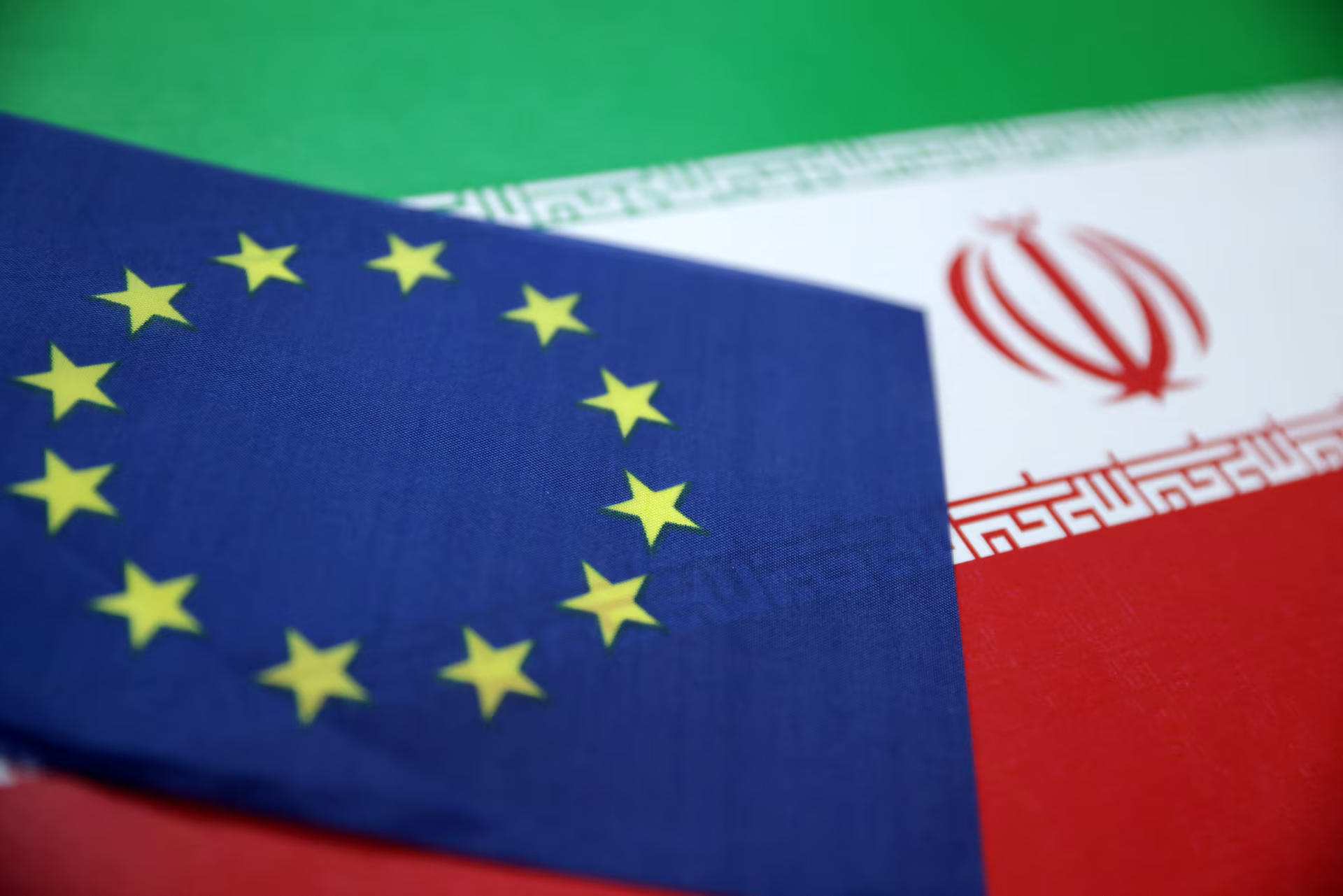
The halls of the Berlaymont building in Brussels are echoing with a familiar, yet increasingly hollow, refrain: “maximum restraint.” As ballistic missiles arc across Middle Eastern skies and the specter of a full-scale US-Iran war becomes a terrifying reality, the European Union’s diplomatic machinery appears jammed.
The bloc’s response to the latest escalation—a series of lukewarm press releases and hurried phone calls—has drawn sharp criticism from geopolitical analysts and internal critics alike. While Washington shifts to a war footing and Tehran abandons the last vestiges of nuclear compliance, the EU remains trapped in a cycle of indecision.
This is not merely a diplomatic hiccup; it is a fundamental breakdown of the EU’s ambition to be a “geopolitical commission.” The inability to project power or offer a unified alternative to military escalation is exposing the deep structural fractures between Europe’s most powerful capitals.
## A House Divided: The Paris-Berlin Schism
At the heart of the paralysis lies a fundamental disagreement between France and Germany on how to navigate the erupting conflict.
French President Emmanuel Macron has reportedly pushed for a more assertive “Strategic Autonomy” approach. Sources within the Elysée suggest France is frustrated with Brussels’ subservience to American military strategy. Macron’s camp argues that Europe must act as a distinct third pole, capable of mediating between Washington and Tehran without being dragged into a “forever war.”
In contrast, Berlin remains tethered to the Transatlantic alliance. For Chancellor Olaf Scholz, any move that creates a public rift with the United States is seen as a risk to European security, particularly with the ongoing conflict in Ukraine stretching resources thin. Germany’s hesitation to condemn US unilateralism has effectively vetoed any collective European action that carries actual weight.
> “The EU is attempting to fight a 21st-century fire with a 20th-century bucket brigade,” says Dr. Aris Vos, a senior fellow at the Center for Mediterranean Studies. “While Paris wants a fire engine, Berlin is worried about the cost of the water. Meanwhile, the Middle East is burning.”
## The Failure of ‘Maximum Restraint’
The phrase “maximum restraint” has become a punchline in diplomatic circles. It is a linguistic shield used by the European External Action Service (EEAS) to mask a vacuum of policy.
Recent data points to the irrelevance of this rhetoric:
– **Nuclear Fallout:** Iran has effectively ceased all cooperation with the IAEA, citing European failure to protect the JCPOA (the 2015 Nuclear Deal) from US sanctions.
– **Economic Impotency:** INSTEX, the European special-purpose vehicle designed to bypass US sanctions and trade with Iran, has been a categorized failure, facilitating nearly zero significant transactions.
– **Security Dependency:** Despite the talk of “Strategic Autonomy,” over 70% of European intelligence regarding Iranian missile movements still originates from US assets.
The EU’s insistence on a middle path has left it marginalized. Washington views Brussels as a secondary player that offers little military utility, while Tehran views the EU as a “paper tiger” that promises economic relief it cannot deliver.
—
## The Cost of Neutrality
The criticism is not coming solely from outside. Members of the European Parliament have begun to openly lambasting the High Representative for Foreign Affairs, Josep Borrell. Critics argue that by failing to take a decisive stand, the EU is inviting the very instability it fears.
The implications of this inaction are three-fold:
1. **Energy Insecurity:** A full-scale war in the Strait of Hormuz would see global oil prices skyrocket, hitting European industries already reeling from the loss of Russian gas.
2. **Migrant Pressures:** Further destabilization in the Middle East inevitably leads to increased displacement, a political third rail that threatens to fracture European domestic politics.
3. **Institutional Irrelevance:** If the EU cannot influence a conflict on its doorstep that directly affects its interests, its claim to global leadership is effectively dead.
The “restraint” Brussels calls for is increasingly interpreted by both the US and Iran as “withdrawal.”
## The Investigative Reality: A Bloc in Retreat
Our investigation reveals that behind the scenes, smaller member states are growing increasingly restless. Poland, the Baltics, and Nordic countries are wary of any French-led initiative that might alienate the US, viewed as their primary defender against Russian aggression.
This “security dilemma” means that the EU is incapable of forming a coherent Middle East policy because its members are prioritising their Eastern Flank security. The result is a neutralized foreign policy.
> “We are witnessing the death of European diplomacy as a credible force,” says a high-ranking EU diplomat who requested anonymity. “The Americans don’t call us for advice; they call us to tell us what they’ve already decided. We then translate those decisions into ‘diplomatic-speak’ and call it a policy.”
—
## Impact: What Happens Next?
The window for European mediation is closing, if not already shut. As the US and Iran continue to exchange fire, the EU’s role will likely be relegated to that of a “humanitarian cleanup crew.”
Expect to see:
– **Increased Emergency Funding:** Brussels will likely announce massive aid packages for regional refugees to compensate for its lack of political influence.
– **Fragmented Sanctions:** Individual member states may begin to pursue their own “mini-policies” toward Iran, further eroding the bloc’s unity.
– **A Return to Bilateralism:** The US will likely bypass the EU institutions entirely, dealing directly with Paris, Berlin, and London as separate entities.
The “Maximum Restraint” era is over. It has been replaced by a “Maximum Irrelevance” reality. Unless the EU can bridge the gap between French ambition and German caution, it will remain a spectator in a war that will define the next decade of global power.
Related Stories
- Khamenei Dead? The Secret Intelligence Tunnels Behind Netanyahu’s Assassination Claims
- The Global Oil Price Spike: Why the Iran Attack Will Hit Your Pocket This Week
- Nuclear Breakdown: The Secret Documents Trump Claims Prove Iran’s Nuclear Deception
- Mexico’s ‘Reign of Terror’: Who Fills the Power Vacuum After El Mencho’s Execution?

