
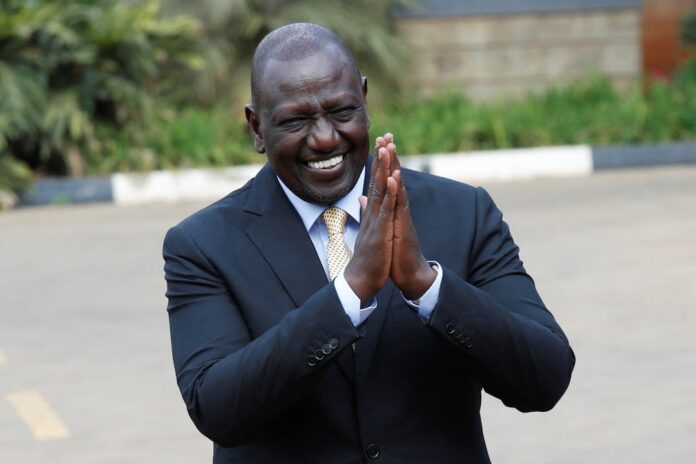
UDA politician Nathaniel Mong’are has defended President William Ruto’s development record while predicting divisions within the opposition ahead of the 2027 General Election. Speaking during an interview with Jeff Koinange on Citizen TV, Mong’are argued that Ruto’s growing political partnership with ODM, combined with the government’s development agenda, could make the opposition’s path to State House increasingly difficult.
Highlights
- Mong’are predicts divisions within the opposition ahead of the 2027 election nominations.
- He describes the emerging Ruto-ODM partnership as a strong political alliance.
- He defends the UDA administration’s record, awarding it an A or A-minus.
- He outlines ambitious infrastructure and agricultural development proposals.
- He highlights major road projects, including the Isiolo-Wajir-Mandera highway.
Main Story
Mong’are Predicts Opposition Disunity Ahead of 2027 Elections
Nathaniel Mong’are has predicted that Kenya’s opposition could experience significant divisions as the country moves closer to the 2027 General Election.
During an interview with Jeff Koinange on Citizen TV, Mong’are suggested that political differences among opposition leaders would become more apparent around February or March next year, as the country approaches the electoral nomination period.
He argued that a fragmented opposition would struggle to challenge President William Ruto, particularly with the political partnership between UDA and ODM taking shape.
Mong’are described the emerging relationship as a strong political arrangement, arguing that it could significantly strengthen Ruto’s position ahead of the next election.
Mong’are Defends Ruto’s Development Record
The UDA politician also mounted a strong defence of the government’s performance, arguing that President Ruto deserves a high rating for implementing the party’s manifesto.
He claimed that the administration had made progress across several sectors, including infrastructure, agriculture, technology and employment creation.
Mong’are further criticised the opposition, particularly DCP, arguing that it had yet to present a comprehensive alternative development programme.
He also invoked the late former Prime Minister Raila Odinga, saying he missed his ability to challenge the government with clearly articulated policy alternatives.
According to Mong’are, political competition should involve presenting workable solutions rather than simply criticising the government.
He subsequently gave the Ruto administration an A or A-minus for what he described as its commitment to delivering the UDA manifesto.
Ruto’s First-World Kenya Vision and Gen Z Support
Mong’are also addressed the role of young voters in the coming election, arguing that a significant section of Gen Z could support Ruto and the UDA government in 2027.
He described the political environment as a contest between what he termed a silent majority and a vocal minority.
He further claimed that some young people had been influenced by political actors he accused of misleading them, but maintained that more youths were beginning to recognise the government’s development ambitions.
Mong’are said the administration’s long-term vision was to transform Kenya into a first-world economy through investments in infrastructure, agriculture, technology and employment opportunities.
Ambitious Agricultural and Infrastructure Projects
On agriculture, Mong’are outlined proposals aimed at reducing the country’s dependence on rainfall by expanding water storage and irrigation infrastructure.
Among the projects he highlighted were:
- Construction of 50 large-scale dams.
- Development of 200 medium-sized dams.
- Construction of 1,000 small dams.
- Greater private-sector participation through the proposed National Infrastructure Fund.
He argued that improving water availability would strengthen food production and reduce Kenya’s vulnerability to unreliable rainfall.
On infrastructure, he also highlighted a proposed expansion of the country’s road network, including an ambition to construct 20,000 kilometres of tarmac roads.
According to Mong’are, such investments would create employment opportunities for young people while improving access to markets and supporting businesses, including micro, small and medium enterprises (MSMEs).
He also mentioned the Hustler Fund and infrastructure programmes as some of the initiatives expected to support economic opportunities for ordinary Kenyans.
Mong’are Highlights Major Regional Road Projects
The politician further defended the government’s infrastructure priorities, pointing to major transport corridors that he believes are important for economic growth and regional equality.
He cited the Isiolo-Wajir-Mandera road, which he described as a 750-kilometre project, arguing that its development would improve connectivity in northern Kenya.
He also called attention to the Mombasa-Nairobi-Malaba transport corridor, emphasising its importance to trade between Kenya and Uganda.
Mong’are argued that the route deserved greater attention because Uganda is one of Kenya’s biggest trading partners.
He maintained that upgrading and expanding these roads would improve transportation, facilitate cross-border commerce and help address longstanding regional development gaps.
As the 2027 election approaches, Mong’are’s remarks offer a glimpse into how UDA allies intend to frame the administration’s record and campaign message.
However, whether the proposed projects, political alliances and development promises will translate into electoral support remains a question that voters will ultimately answer at the ballot.
With the 2027 General Election approaching, political alliances, development promises and the Gen Z vote are becoming increasingly important to Kenya’s political conversation. But beyond the competing claims from political leaders, the ultimate question remains: Will Kenyans be convinced by the government’s development record, or will the opposition succeed in presenting a more appealing alternative?

