
US President Donald Trump’s ambitious plan to construct a towering triumphal arch in Washington, DC, has suffered a legal setback after a federal judge temporarily stopped the project, just hours after it received approval from a government planning commission.
District Judge Tanya Chutkan issued a 14-day restriction barring the administration from beginning construction as legal challenges over the monument’s authorisation, location and potential impact continue to unfold.
The proposed 250-foot structure has sparked widespread opposition, particularly because of its planned location near Arlington National Cemetery, where hundreds of thousands of American service members are laid to rest.
Highlights
- US Judge Tanya Chutkan has temporarily blocked construction of Trump’s proposed triumphal arch.
- The 250-foot monument received an 8-4 approval vote from the National Capital Planning Commission.
- Veterans and officials from Washington and Virginia have challenged the project’s legality.
- Critics have raised concerns about its proximity to Arlington National Cemetery.
- The court’s intervention comes amid broader legal disputes over Trump’s redevelopment projects in Washington.
Main Story
Judge Halts Construction Despite Federal Approval
President Donald Trump’s proposed triumphal arch in Washington, DC, has been temporarily stopped after a federal court intervened in the project.
District Judge Tanya Chutkan issued an order preventing the administration from undertaking construction work for 14 days as she considers legal challenges filed against the development.
The decision came shortly after the National Capital Planning Commission voted 8-4 in favour of approving the proposed monument on Thursday, November 5, 2026.
The commission’s decision followed several hours of public hearings during which veterans, lawmakers, preservation groups and members of the public raised objections to the project.
Despite the opposition, the panel proceeded with the approval, paving the way for the administration to move towards construction.
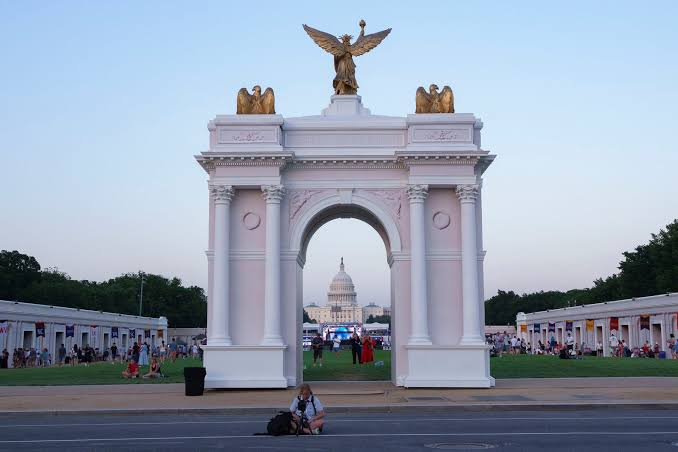
However, Chutkan’s intervention has temporarily stopped those plans while the court examines the outstanding legal questions.
Why Trump’s Monument Is Facing Opposition
At approximately 250 feet (76 metres) tall, the proposed arch would become a major addition to Washington’s landscape.
Its planned location at Memorial Circle, near Arlington National Cemetery and across the Potomac River from the Lincoln Memorial, has become one of the biggest sources of disagreement.
The structure would also exceed the height of Paris’ famous Arc de Triomphe, which reportedly inspired Trump’s proposal.
Opponents argue that introducing such a massive structure near a national burial ground could interfere with the dignity and historical significance of the surrounding memorial sites.
The project has also raised questions about whether the administration has obtained the necessary congressional authorisation and funding to proceed.
Legal Questions Over Historical Authorisation
One of the administration’s main arguments is that Congress approved the construction of a monument at Memorial Circle more than a century ago.
However, critics say the earlier proposal was significantly different from Trump’s current design.
The historical plan involved two columns representing the Northern and Southern sides of the American Civil War rather than the enormous triumphal arch now being proposed.
The four commissioners who opposed Thursday’s approval had called for the decision to be postponed.
They cited unresolved legal questions, the absence of congressional funding approval and concerns about claims that the structure would serve a military or national security purpose.
The administration’s position has also faced scrutiny over the extent to which the proposed monument would have any clearly established security functions. Reuters+2
Veterans and Government Officials Challenge Project
The legal battle has attracted opposition from veterans and public officials who believe the project should not proceed without further scrutiny.
Several veterans and an architectural historian filed a lawsuit seeking to prevent construction, arguing that the administration had not demonstrated sufficient legal authority to build the monument.
The attorneys general of Washington, DC, and Virginia also moved to stop the development, raising concerns about traffic disruption, environmental consequences and potential interference with emergency services.
Judge Chutkan’s latest order granted the request for temporary intervention, giving the court additional time to examine the arguments presented by the parties.
The ruling does not permanently cancel the project but prevents construction from moving forward during the 14-day restriction. AP News+2
Lawmakers Warn Contractors Over Legal Risks
Opposition to the project was also evident during the commission’s public hearing, where more than 100 participants reportedly voiced concerns.
Among those who addressed the commission was Democratic Congressman Jared Huffman, who questioned the legality of the development and warned companies considering involvement in the construction.
Huffman argued that contractors and officials should carefully consider the potential legal consequences of proceeding before the outstanding disputes are resolved.
His remarks also reflected the changing political environment following the November 3 midterm elections, which saw Democrats secure control of Congress.
The change is expected to give Democratic lawmakers greater opportunities to scrutinise the administration’s spending decisions and development projects through congressional oversight.
Trump Faces Other Legal Battles Over Washington Projects
The proposed arch is part of Trump’s wider efforts to reshape Washington, DC, through major construction and renovation initiatives.
One of the most controversial projects is a planned White House ballroom, which involved the demolition of an entire section of the presidential residence to create space for the proposed development.
That project also attracted legal opposition, although the Supreme Court eventually ruled that the individual who filed the challenge lacked the legal standing required to pursue the case.
Trump has additionally pushed for renovations at the Reflecting Pool and changes to the historic East Potomac Golf Links.
The golf course redevelopment faced opposition after plans involving the removal of hundreds of trees prompted legal intervention.
The latest ruling therefore adds another legal challenge to the administration’s efforts to transform several prominent public spaces in the American capital.
What Happens Next?
For now, Trump’s triumphal arch remains on hold as the court considers the arguments surrounding its construction.
The administration will have to navigate the ongoing legal proceedings before it can proceed with the development.
The dispute has also opened a wider conversation about presidential authority, congressional oversight and the protection of historically significant public spaces.
Whether the proposed monument eventually becomes part of Washington’s skyline will depend partly on how the courts resolve the legal questions surrounding the project.
The proposed arch may be intended to become a lasting symbol of American history, but its future now rests on a fundamental question: how far can a president go in reshaping national landmarks without congressional approval and legal consensus?

