
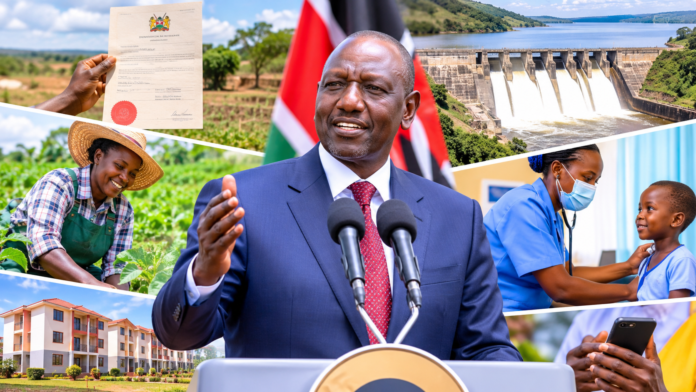
President William Ruto has outlined a series of government interventions targeting the cost of living, land ownership, healthcare, affordable housing and agricultural productivity, while highlighting plans to expand economic opportunities for ordinary Kenyans.
In his latest remarks, the President discussed initiatives ranging from issuing title deeds and expanding irrigation infrastructure to supporting persons living with disabilities and introducing proposed tax changes aimed at increasing disposable income among low-income workers. He described the measures as part of his administration’s broader approach to promoting equity and improving living standards across the country.
Highlights
- Ruto says nearly 1.8 million title deeds have been issued since August 2022, including over 400,000 at the Coast.
- The government is targeting 2.5 million acres under irrigation through major water infrastructure projects.
- Affordable housing developments are reportedly underway across all 47 counties.
- The President has proposed exempting workers earning Sh32,333 or less from PAYE.
- The government says it has approved Sh27.68 billion to settle 28,726 verified pending bills.
Main Story
Ruto Highlights Land Ownership and Equal Opportunities
President William Ruto has placed land ownership, economic inclusion and equal access to public services at the centre of his administration’s equity agenda.
Addressing the challenges faced by persons living with disabilities, the President said the government was working to improve access to financial resources, skills development, business opportunities and public procurement.
He pointed to initiatives such as NYOTA and AGPO, which are intended to help historically disadvantaged groups participate in economic activities and grow their businesses.
Ruto also highlighted agricultural support programmes targeting smallholder farmers, pastoralists and fishing communities, particularly those living in arid and semi-arid regions.
On land ownership, the President said approximately 1.8 million title deeds had been distributed across the country since August 2022.
According to him, more than 400,000 of these documents had been issued in the Coast region, while community land titles in Taita, Kilifi and Lamu were helping families secure formal recognition of their ancestral land.
He argued that land documentation provides families with greater security, protects inheritance rights and creates opportunities for investment.
The President also addressed identification challenges in Northern Kenya and other border counties, saying discriminatory requirements had been eliminated to ensure citizens could access government services without facing additional hurdles based on their backgrounds.
Government Targets 2.5 Million Acres Under Irrigation
Ruto has also emphasised the importance of water infrastructure in transforming Kenya’s agricultural sector.
He argued that relying heavily on rainfall limits farmers’ ability to maintain consistent production, making irrigation investments necessary for improving food security and agricultural earnings.
Under the government’s proposed water development programme, the administration is targeting the construction of at least 50 mega dams, 200 medium and small dams, alongside thousands of water harvesting structures.
The broader ambition is to expand the area under irrigation to at least 2.5 million acres.
According to the President, improved water availability would support agricultural production throughout the year while also serving households and industries.
He further linked agricultural growth to investments in roads and electricity, explaining that better transport infrastructure would help farmers reach markets while reliable energy would support production and processing.
Ruto maintained that combining these investments could strengthen Kenya’s productive capacity and create opportunities in agriculture, manufacturing and the service economy.
Ruto Explains Healthcare and Affordable Housing Plans
Healthcare access and decent housing also featured prominently in the President’s explanation of his administration’s equity agenda.
Using the example of a mother of three who is also a small-scale farmer, Ruto described how healthcare support could help an ordinary Kenyan family manage medical emergencies without facing overwhelming financial pressure.
He said an additional 25.7 million Kenyans had joined the healthcare system, arguing that the programme was intended to ensure more citizens could access medical assistance when needed.
The President presented the initiative as an example of shared responsibility, where contributions from different members of society help support those requiring medical care.
On housing, he said affordable housing projects were being implemented across all 47 counties.
The programme also includes student accommodation projects targeting universities, Technical and Vocational Education and Training institutions (TVETs), and Kenya Medical Training College (KMTC) campuses.
Additionally, the government is developing modern markets intended to provide traders with improved working environments.
Ruto defended the housing levy, explaining that contributions are based on earnings and are intended to support the development of affordable homes for Kenyans who cannot easily access decent housing.
He said the objective was to improve living conditions for families currently dealing with inadequate housing, poor sanitation and overcrowded environments.
Government Proposes Tax Changes to Increase Disposable Income
The President also outlined several proposed financial and tax interventions that his administration says could help reduce household expenses and leave workers with more money.
Among the proposals is an exemption from Pay As You Earn (PAYE) for employees earning Sh32,333 or less.
The government has also proposed removing stamp duty on land transactions valued at up to Sh1 million.
Another proposal involves eliminating the 25 per cent import duty currently referenced in the President’s remarks on mobile phones.
These measures were presented alongside existing interventions targeting agricultural production, healthcare expenses, education and infrastructure development.
Ruto said affordable fertiliser and improved earnings from cash crops and dairy farming were expected to support agricultural households.
He also linked the expansion of digital employment, housing construction and infrastructure projects to efforts to increase income opportunities and reduce business operating costs.
Sh27.68 Billion Approved for Pending Bills
Beyond the proposed tax changes, the President announced that the government had approved the settlement of 28,726 verified pending bills worth Sh27.68 billion.
He said the move was intended to restore cash flow to businesses and individuals who had supplied goods and services to government institutions but were yet to receive payment.
The administration also approved Sh18 billion for universities and another Sh16 billion for hospitals under the former National Hospital Insurance Fund (NHIF).
According to Ruto, settling these outstanding obligations would help institutions maintain operations, protect employment and support livelihoods.
The President presented the different interventions as interconnected efforts aimed at addressing the financial pressures facing households while expanding access to economic opportunities.
However, the proposed tax adjustments and the implementation of the various development programmes remain important areas for Kenyans to follow as the government moves towards delivering on its commitments.
As Kenya pursues these ambitious development and economic plans, the bigger question remains: how quickly will the promises translate into meaningful improvements in the everyday lives of ordinary citizens?

