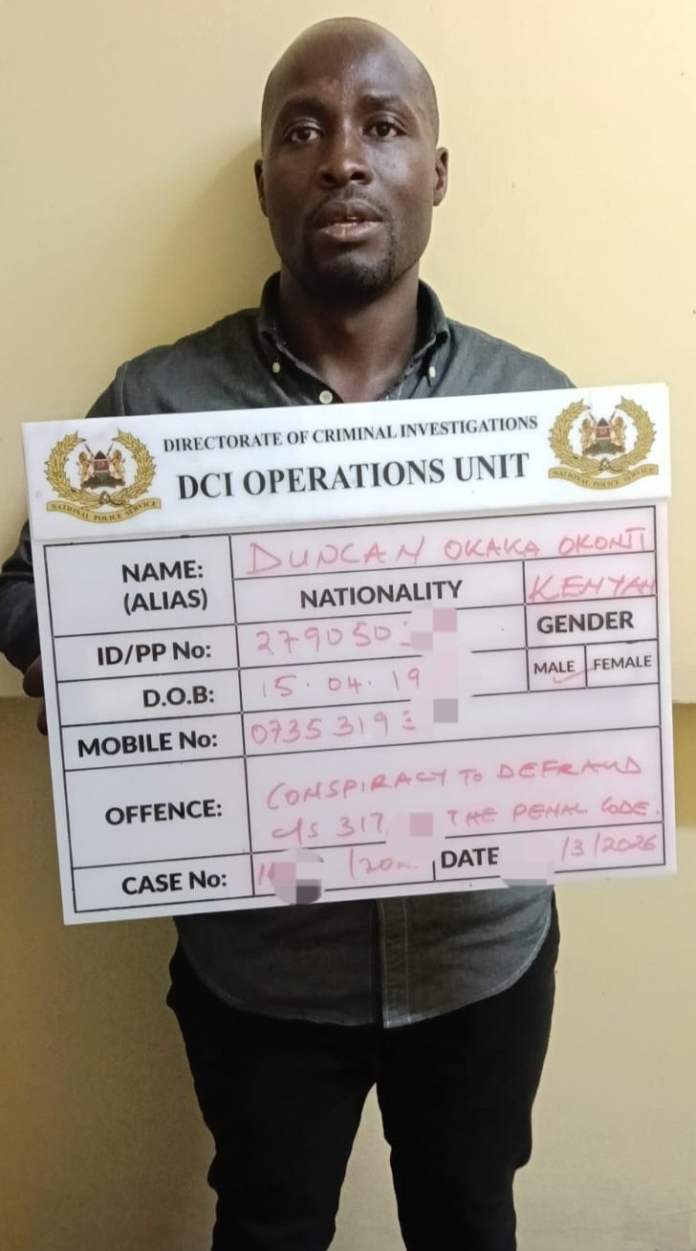
A Kenyan man is at the centre of a high-stakes international fraud case after allegedly orchestrating a fake gold deal that cost an Australian investor over KSh 77 million. The suspect appeared in court this week as authorities intensify efforts to dismantle transnational scam network
Highlights:
- Suspect linked to USD 600,000 fake gold transaction
- Victim reportedly lured through elaborate international scheme
- Arrest made in Nairobi after months-long investigation
- Court grants bail as case set for April hearing
Main Story:
Arrest and Court Appearance
A Nairobi court has charged Duncan Okaka Okonji over his alleged role in a fraudulent gold deal involving hundreds of thousands of dollars. The suspect was apprehended on March 24, 2026, before being presented at the Milimani Law Courts the following day.

He faces charges of conspiracy to defraud under Kenyan law but pleaded not guilty during his arraignment. The court allowed his release on a bond of KSh 5 million or a cash bail alternative of KSh 1 million, alongside conditions requiring two contact persons. The matter will be mentioned again on April 7, 2026.
How the Scheme Unfolded
Investigators say the case traces back to October 2025 when the complainant, an Australian national, was approached while in Dubai. He reportedly met an individual posing as a foreign investor who introduced him to the Kenyan suspect.
The suspect allegedly claimed he could facilitate the purchase and shipment of a large gold consignment weighing nearly 600 kilograms.
Cross-Border Deception
To build credibility, the victim was reportedly taken on a trip to Tanzania, where he was shown what appeared to be legitimate mining operations. He was later brought to Kenya, where a series of meetings and documents were presented to reinforce the illusion of a genuine transaction.
Authorities believe these carefully staged interactions were meant to convince the investor that the gold shipment to Dubai was legitimate and imminent.
Money Trail and Investigation
Convinced by the setup, the complainant is said to have transferred USD 600,000 through a law firm. However, suspicions arose shortly after, prompting him to report the matter to the Directorate of Criminal Investigations (DCI).
The DCI has since launched a probe into the case, describing it as part of a wider effort to dismantle organised fraud networks operating across borders. Investigators are also working to trace and recover the lost funds.
The agency has reiterated its commitment to cracking down on sophisticated scams targeting foreign investors, noting that such schemes often involve multiple players and carefully coordinated deception.
As authorities dig deeper into the case, it raises a bigger question how many more are falling victim to deals that glitter like gold but turn out to be nothing more than well-polished scams?

