
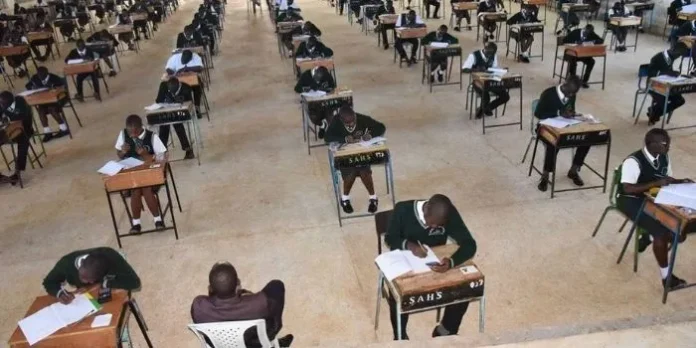
Thousands of KCSE candidates across Kenya are heading into another demanding examination week, with Mathematics and Kiswahili Fasihi scheduled for Monday as the 2026 national examinations enter their fourth week.
As learners prepare to tackle the written papers, the Kenya National Examinations Council (KNEC) and the Ministry of Education have maintained strict security arrangements to prevent cheating, examination leaks and other forms of malpractice.
Highlights
- KCSE candidates are scheduled to sit Mathematics and Kiswahili Fasihi on Monday.
- Mathematics is offered under Alternative A and Alternative B, with candidates sitting only one option.
- Standard written examination papers will take two hours and 30 minutes.
- Examination centres have at least two armed police officers guarding them.
- KNEC has introduced electronic locks and tracking features to strengthen examination security.
Main Story
KCSE Candidates Enter Another Week of Written Examinations
The 2026 Kenya Certificate of Secondary Education (KCSE) examinations are progressing into another week, with candidates expected to sit Mathematics and Kiswahili Fasihi on Monday.
The examinations are now in their second week of written theory papers, following the commencement of oral and practical assessments on October 19.
According to the examination schedule, standard written papers, including large-print versions, will run for two hours and 30 minutes. Candidates using Braille examination papers will receive an additional 30 minutes, bringing their examination duration to three hours.
Understanding Mathematics Alternative A and B
One of the important aspects of Monday’s examination is the Mathematics paper, which is administered under two different options: Alternative A and Alternative B.
Candidates are required to sit only the option registered for them.
Mathematics Alternative A
Alternative A follows the conventional secondary school Mathematics syllabus and is undertaken by most KCSE candidates.
The paper covers a wide range of mathematical concepts and is particularly relevant to learners planning to pursue university and diploma courses in fields such as engineering, medicine, technology, sciences and finance.
Mathematics Alternative B
Alternative B provides a different approach to Mathematics, with greater attention given to basic mathematical understanding and practical applications.
Developed through the curriculum and examination frameworks overseen by the Kenya Institute of Curriculum Development (KICD) and KNEC, the option focuses more heavily on foundational concepts, particularly those covered in Forms One and Two.
It is designed to support learners pursuing vocational training, humanities, arts and general trade-related career pathways, where advanced mathematical concepts may be less central.
How the Mathematics Papers Are Structured
Both Mathematics alternatives are assessed through two written papers, namely Paper 1 and Paper 2.
Each paper contains two main sections.
- Section I: Features compulsory short-answer questions that every candidate must attempt.
- Section II: Contains structured questions from which candidates select according to the examination instructions.
The format allows examiners to assess candidates’ understanding of mathematical principles, problem-solving abilities and their capacity to apply concepts.
KNEC Tightens Security at Examination Centres
Beyond the examination timetable, authorities have maintained heightened security measures to protect the credibility of the 2026 KCSE examinations.
Every examination centre is required to have at least two armed police officers providing security throughout the exercise.
Candidates and examination officials are also prohibited from carrying mobile phones and smartwatches into examination centres.
KNEC has additionally introduced electronic security systems to monitor the storage of examination materials.
Containers holding examination scripts are fitted with smart padlocks that can be monitored remotely from the council’s headquarters.
The locks are programmed to allow access from 7am, when centre managers are expected to collect the day’s examination materials.
Any unauthorised attempt to open or interfere with the containers before the designated time triggers an alert at KNEC headquarters.
Special Features Introduced to Trace Examination Leaks
Authorities have also introduced additional measures aimed at identifying individuals involved in photographing and circulating examination papers online.
Morning and afternoon examination materials are packaged separately in colour-coded cartons.
The papers also contain anonymised watermarks and tracking features designed to help investigators establish the source of any leaked examination material.
These security features are intended to discourage candidates and examination officials from sharing confidential papers through social media platforms and other digital channels.
The measures follow growing efforts by KNEC to use technology to strengthen examination monitoring and accountability.
Teachers and Examination Officials Face Tough Penalties
The Teachers Service Commission (TSC) and the Ministry of Education have also warned teachers, invigilators and other examination officials against facilitating cheating.
Officials found participating in examination malpractice risk immediate disciplinary action, prosecution and possible imprisonment.
The warning extends to anyone who helps candidates access prohibited devices, obtains examination papers unlawfully or participates in distributing confidential examination materials.
As the written papers continue, authorities are urging candidates to follow examination regulations and rely on their preparation rather than attempting to gain an unfair advantage.
With several examination days still ahead, maintaining discipline and protecting the integrity of the process remain key priorities.
As thousands of candidates continue their KCSE journey, the focus remains on preparation, discipline and fair assessment. Beyond the grades they hope to achieve, the examinations are another important step towards the futures they are working to build.

