
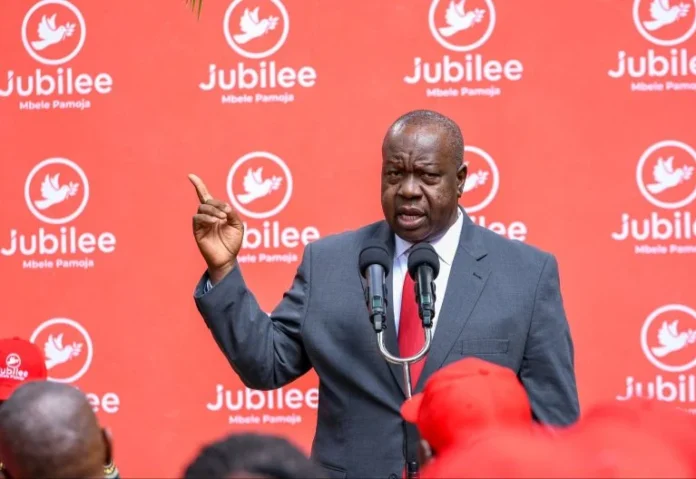
ubilee Party presidential aspirant Fred Matiang’i has pledged to make the fight against corruption a key priority of his 2027 campaign, promising to keep both himself and his family away from government contracts if elected president.
Speaking on October 7, 2026, the former Cabinet Secretary said Kenya already has sufficient laws and institutions to tackle graft, arguing that what is missing is leadership willing to enforce the rules consistently.
Highlights
- Matiang’i says he would keep his family out of government business.
- He argues Kenya does not need additional anti-corruption bodies.
- The former CS says leaders must set an example in the fight against graft.
- He has questioned the management of several public programmes and projects.
- His governance message comes as political parties prepare for the 2027 election.
Main Story
Matiang’i Makes Anti-Corruption Pledge
Fred Matiang’i has placed accountability and the fight against corruption at the centre of his political message ahead of the 2027 General Election.
The Jubilee Party presidential aspirant said he would approach the fight against graft with the same determination he demonstrated while serving as Education Cabinet Secretary, particularly in efforts to curb examination cheating.
He also made a personal commitment that neither he nor his children would conduct business with the government if he became president.
Matiang’i argued that separating personal and family interests from government dealings would help leaders maintain credibility when confronting corruption.
‘We Have Enough Laws’
The former Education and Interior CS said Kenya already has the legal framework and institutions required to deal with corruption.
Rather than establishing additional commissions or passing more laws, he said the country needs leaders who are willing to act decisively and demonstrate integrity through their own conduct.
His argument is that public officials cannot effectively demand accountability from citizens while failing to observe similar standards themselves.
Matiang’i said his own approach to leadership would involve setting an example and avoiding the use of public office as a pathway to personal financial gain.
Matiang’i Questions Management of Public Projects
The Jubilee politician has also criticised the way some government programmes and public systems are being managed.
Among the areas he has raised questions about are the Social Health Authority, the affordable housing programme and the eCitizen platform.
He has pointed to audit concerns surrounding eCitizen, including questions about financial balances and procurement, as issues that require greater scrutiny.
Matiang’i has similarly questioned the state of Kenya’s sugar industry, particularly the continued struggles facing State-owned mills while privately owned companies remain active.
He has attributed some of the industry’s challenges to alleged cartel influence and called for greater accountability in the management of public enterprises.
Linking Exam Security to Election Integrity
Matiang’i has also drawn a connection between his previous work against examination cheating and the need for credible elections.
During his tenure at the Education Ministry, measures were introduced to address examination leaks and cheating. He now uses that experience as part of his argument for stronger enforcement of rules in public institutions.
His campaign message has increasingly focused on leadership, accountability, political integrity and the role of young people in decision-making.
The former CS has also been questioning government decisions on major public projects and agreements. On October 6, he called for greater transparency around the Dangote refinery and other agreements involving public resources, saying Parliament should have access to relevant details.
2027 Political Race Takes Shape
Matiang’i’s anti-corruption message comes as opposition parties continue discussions over how they will approach the 2027 presidential contest.
Jubilee has endorsed him as its presidential candidate, while opposition parties are still holding discussions around possible cooperation and the question of whether they will field a common candidate.
The former CS has positioned accountability, transparency and public service delivery among the issues he intends to emphasise as the political contest gathers momentum.
With corruption, the economy, governance and employment likely to remain major issues in the election debate, Matiang’i’s pledge places his personal conduct and record at the centre of his campaign pitch.
As the 2027 race takes shape, Matiang’i is putting a simple question at the heart of his governance pitch: can leaders demand accountability from the country if they are unwilling to demonstrate it themselves?

