
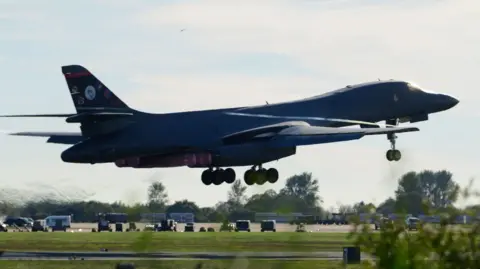
US President Donald Trump has confirmed that Washington moved American bombers out of RAF Fairford in the UK after receiving what he described as threats against the military base.
The Pentagon has confirmed the aircraft were returned to their home stations in the United States, with reports indicating that around a dozen B-1 bombers had been deployed at the Gloucestershire airbase.
Highlights
- Trump says the US received threats linked to RAF Fairford.
- Around a dozen B-1 bombers were reportedly moved from the base.
- The exact nature and source of the threat remain unclear.
- British counter-terrorism officers are investigating a separate incident near the airbase.
- Iran has denied involvement in the reported security incident.
Main Story
Trump Confirms Bombers Were Moved Over Security Concerns
Trump said the decision to remove the aircraft was deliberate and linked to information about a potential threat.
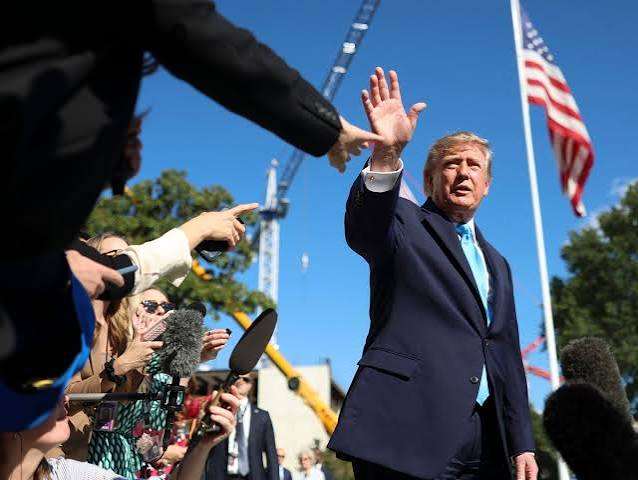
Speaking to reporters before travelling to Nebraska, the US president said American authorities were aware of the threat and chose to relocate the bombers rather than leave them exposed.
He also claimed Washington knew the individuals behind the threat, although he did not identify them or provide evidence supporting the claim.
Trump said the aircraft had not been moved very far and suggested the relocation was intended as a precaution while the situation was assessed.
Pentagon Confirms Aircraft Were Redeployed
The Pentagon confirmed that US bombers stationed at RAF Fairford had been returned to their home bases.
The move comes after the Gloucestershire airbase became the focus of a security investigation following an incident involving several suspicious vehicles near the facility on September 27.
US media reports have suggested the aircraft and military personnel could have been potential targets.
The precise nature of the alleged threat, however, has not been publicly established.
UK Authorities Say Base Remains Safe
The development has raised questions about the security situation around RAF Fairford, which has served as an important forward operating location for the US Air Force for decades.
British officials have maintained that the base remains secure.
A UK government spokesperson pointed to earlier remarks from Trump praising Britain’s police, defence and security services in connection with the situation.
The UK government has also not publicly disputed reports that Washington’s decision to move the bombers was connected to the security incident.
Counter-Terror Police Investigating
The airbase has been under investigation by counter-terrorism authorities following the September incident.
Five men were initially arrested on suspicion of terrorism-related offences before being released on bail. A sixth man, described as a UK-Iranian national, was also arrested and later released on bail.
The investigation has continued as authorities work to establish what happened and whether there was any organised attempt to threaten the facility.
Iran Connection Remains Unconfirmed
The possibility of Iranian involvement has also been raised by US officials and British political figures, although Tehran has strongly rejected any connection to the incident.
Vice-President JD Vance said the bomber relocation was carried out as a precaution and accused Iran of a long history of terrorism-related activity.
US Secretary of State Marco Rubio, however, used more cautious language, saying the movement of military assets around the world was not unusual.
Rubio said American forces routinely redeploy aircraft because of exercises, rotations and operational requirements, while also stressing that Washington continued to have confidence in the security of its bases.
Why RAF Fairford Matters
RAF Fairford has played an important role in US military operations, particularly because of its location and ability to support long-range bomber missions.
In recent months, B-1 and B-52 aircraft have operated from the base in connection with US military activities involving the Middle East.
The UK previously authorised American use of the facility for defensive operations involving Iran.
Defence analysts have warned that moving the bombers away from the UK could reduce America’s ability to quickly launch additional missions against Iran from Europe.
However, the impact may be limited because London’s conditions on the use of RAF Fairford had already restricted the type of operations that could be conducted from the facility.
What Happens Next?
The US could potentially move the aircraft to other locations, including bases in the Gulf or Diego Garcia, depending on available capacity, security considerations and arrangements with allies.
For now, the biggest unanswered question is the exact nature of the threat that prompted the relocation.
With investigations still ongoing, authorities have yet to publicly establish who was behind the alleged threat or what action was being planned against the aircraft and personnel.
As the investigation continues, the movement of the bombers raises a bigger question: how much of a security threat was serious enough to make the US rethink the use of one of its key European airbases?

