
For generations, the Indian Ocean has been the backbone of life along Kenya’s Coast. But for communities such as Shimoni and Wasini Island, the challenge has always been turning that natural resource into reliable, sustainable income.
That picture is beginning to change. Government investment in fishing, aquaculture, marine infrastructure, training and community enterprises is creating new opportunities for fishermen, women and young people with the blue economy emerging as a possible pathway to jobs and businesses closer to home.
Highlights
- Sh3.3 billion in grants has reached 1,263 blue economy groups.
- More than 212,000 people have benefited from the funding and training.
- 875 young people have received training in deep-sea fishing.
- The completed Shimoni Fish Port is expected to strengthen commercial fishing and marine value chains.
- Women and youth are increasingly participating in aquaculture, seaweed farming, crab production and other marine businesses.
Main Story
Shimoni’s Ocean Is Becoming More Than a Fishing Ground
For Asman Ambeta, a tour guide from Shimoni and Wasini Island, the ocean has always been part of everyday life.
When tourism slows down, he turns to fishing to supplement his income — a reality shared by many people living along the Coast.
But Ambeta says coastal communities have faced years of challenges, including declining fish catches, damaged marine ecosystems, inadequate storage facilities and poor returns for fishermen.
Young people have also struggled to find enough opportunities within their own communities.
The growing focus on the blue economy, however, is changing how residents view the ocean.
Ambeta says the completion of the Shimoni Fish Port has made it easier for the community to handle and move fish while creating room for more economic activity.
For him, the development is also significant because Shimoni is one of Kenya’s important coastal points and has historically felt left out of some major development projects.
The Ocean Economy Is Expanding
Fishing remains central to coastal livelihoods, but the blue economy is opening up a much wider range of possibilities.
Tourism, passenger transport, boat services, seaweed farming, aquaculture and marine processing are increasingly becoming part of the conversation.
Seaweed farming, for instance, is creating opportunities for women to earn from products that can be processed into items such as soap and oil.
Ambeta believes this diversification could help young people build sustainable careers without having to leave the Coast in search of opportunities elsewhere.
With improvements in roads, electricity, schools, hospitals and other infrastructure, he sees Shimoni potentially becoming a major economic centre within the next five years.
Sh3.3 Billion Reaches Community Groups
Government-backed programmes are providing financial and technical support to communities seeking to participate in the marine economy.
Through the Kenya Marine Fisheries and Socio-Economic Development Project, commonly known as KEMFSED, 1,263 groups involving 212,033 people have received grants worth Sh3.3 billion.
The programme has particularly targeted women, young people and vulnerable groups, supporting them with training, equipment and opportunities to establish fisheries-related businesses.
The wider intervention is part of efforts to move coastal communities beyond dependence on traditional fishing and towards more diverse income-generating activities.
Young Fishermen Gain New Skills
One of the major areas of investment has been deep-sea fishing.
A total of 875 young people have been trained in the field, giving them skills intended to help them fish further offshore while improving safety and productivity.
The government has also distributed hundreds of fishing boats and supported communities with fish cages and other equipment.
For fishermen who previously relied on small traditional canoes, access to motorised boats can make it possible to reach fishing grounds that were previously difficult to access.
In Kwale, the support has helped some fisherfolk venture further offshore in search of larger catches.
Women Are Finding New Opportunities
The blue economy is also creating space for women to move into areas of the fisheries sector that have traditionally been dominated by men.
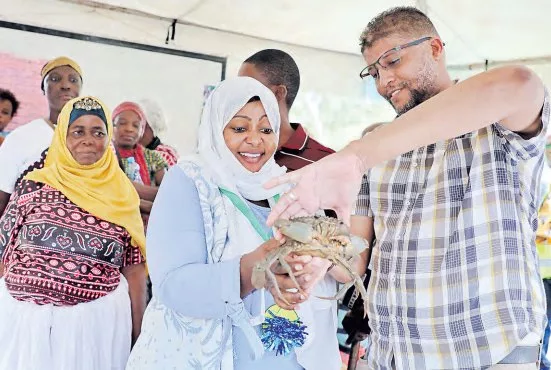
In Jomvu, for example, women involved in the Jomvu Women in Fisheries Community-Based Organisation have ventured into mud crab fattening.
The group received support through KEMFSED to establish crab cages and develop an ecotourism boardwalk.
The women have also been involved in mangrove restoration, planting more than 700,000 seedlings while working to protect important breeding areas for marine life.
Their experience shows how conservation and income generation can work together when communities have the resources to participate.
New Marine Businesses Take Shape
Beyond traditional fishing, communities are exploring aquaculture and other marine enterprises.
These include fish cage farming, shrimp production, mud crab fattening and marine tilapia.
Such activities can help households spread their sources of income instead of relying entirely on wild fish catches.
There is also potential for additional businesses around processing, packaging, transportation and marketing.
That means the economic impact of the blue economy does not necessarily stop when fish or other marine products are harvested. More value can be created further along the supply chain.
Shimoni Port Adds a Major Piece to the Puzzle
Infrastructure remains crucial if coastal communities are to benefit fully from their marine resources.
The Sh2.7 billion Shimoni Fish Port has been completed, alongside a national mariculture centre of excellence valued at Sh1.4 billion.
The facility is intended to strengthen fish handling, storage and processing while supporting research and development in marine aquaculture.
The mariculture centre is working on areas including marine tilapia, shrimp and rabbit fish production.
Other modern fish landing facilities are also being developed across the country, with investments including cold storage, ice-making equipment and processing areas.
Better infrastructure can help reduce losses after fish are landed while giving fishermen improved access to markets.
Building a Stronger Blue Economy
The government has also been working to strengthen Beach Management Units, community-based organisations that play a role in managing fisheries alongside government agencies.
There are about 450 BMUs across the country, with women making up a significant share of their membership.
Efforts are underway to help these groups establish and register marketing cooperatives, which could improve their access to markets and strengthen their bargaining position.
At the same time, authorities have increased efforts to tackle illegal, unreported and unregulated fishing through enforcement, patrols and improved safety measures.
The Challenges Have Not Disappeared
Despite the progress, experts and people within the fishing sector continue to point to significant challenges.
Declining fish stocks, pollution and illegal fishing remain concerns.
There are also questions about whether local fisherfolk are benefiting enough from the growth of aquaculture, particularly where establishing fish farms requires significant capital.
The opportunity, therefore, is not simply to grow Kenya’s blue economy but to ensure that coastal communities have ownership and meaningful participation in it.
If more local fishermen can access fish cages, equipment, financing and technical support, aquaculture could create additional income while reducing pressure on wild fish stocks.
From Living Beside the Ocean to Building From It
Kenya’s coastline has always been rich in natural resources. The emerging blue economy is about turning that potential into sustainable livelihoods.
For someone like Ambeta, the bigger promise is not simply catching more fish.
It is having a Coast where a young person can work in fishing, tourism, aquaculture, transport, conservation or marine processing without feeling that leaving home is the only route to a better future.
The message is simple: Bahari ni uchumi.
And if investment, skills and infrastructure reach the people who depend on the ocean, that economy could become one of the Coast’s strongest engines of opportunity.
The Coast has never lacked an ocean; the real transformation will be measured by whether the people who call its shores home can build lasting prosperity from it.

