
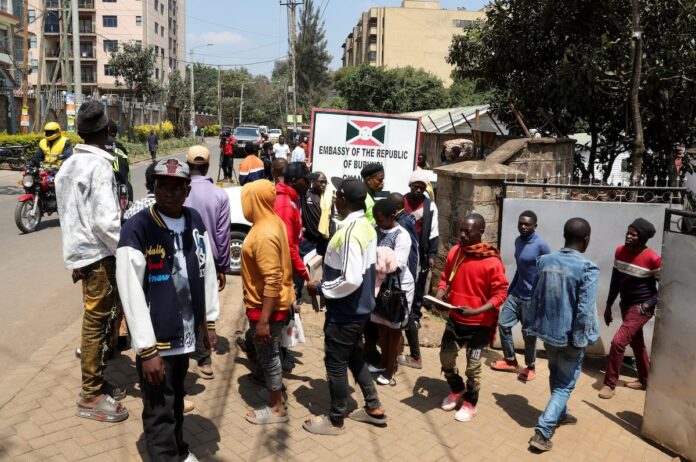
Hundreds of Burundian nationals gathered at their embassy in Nairobi seeking travel documents to return home, saying they no longer feel safe in Kenya despite the government’s decision to give undocumented East Africans 90 days to regularise their status.
The rush to leave follows President William Ruto’s directive targeting foreign nationals operating small-scale businesses, a move that has triggered anxiety among some migrant communities and renewed debate over how Kenya balances local economic interests with regional integration.
Highlights
- Hundreds of Burundians sought travel documents at their Nairobi embassy.
- Some said they feared harassment and insecurity in Kenya.
- The government has offered undocumented foreigners 90 days to regularise their status.
- Authorities have warned against xenophobia and violence targeting foreign nationals.
- Some Burundians said they had already made up their minds to return home.
Main Story
Burundians Gather at Embassy
The situation has left many Burundian nationals reconsidering their future in Kenya, with hundreds turning up at their embassy in Nairobi to obtain documents needed to travel home.
Some said they were not convinced that the government’s 90-day regularisation window would make them feel secure enough to remain in the country.
For traders and other small-scale business operators, the uncertainty has been particularly worrying following the government’s recent position on foreign-owned small businesses.
‘We Feel Unwanted’
Some Burundians interviewed at the embassy described a growing sense of hostility.
Habonimana Jacques, a motorcycle taxi operator, said he believed the government’s messaging had contributed to an environment where some foreigners felt exposed to harassment.
Another Burundian, Eric Niyonkur, who sells second-hand clothes, said he had reached the point where returning home felt like the safer option.
He also claimed that some people had spent days at the embassy while waiting for assistance, highlighting the level of concern among those seeking to leave.
Government Offers 90-Day Amnesty
The Kenyan government has sought to clarify that undocumented foreign nationals will have time to put their immigration affairs in order.
Presidential spokesperson Hussein Mohamed said people without the necessary documentation should use the 90-day window to regularise their stay.
He added that enforcement measures would begin once the grace period expires.
The government has also maintained that foreigners who are properly registered and working in sectors where they are legally permitted to operate will continue to have their rights protected.
Warning Against Xenophobia
At the same time, authorities have warned Kenyans against turning the debate over foreign traders into hostility towards entire communities.
The presidency said discrimination, violence and lawlessness against foreign nationals would not be tolerated.
The warning comes as concerns grow that the focus on protecting opportunities for Kenyan traders could spill over into harassment of foreigners who are legally living and working in the country.
A Regional Issue
The developments also come against the backdrop of East Africa’s regional integration efforts, where citizens of neighbouring countries regularly move across borders for work, trade and business.
Kenya hosts thousands of Burundian refugees and asylum seekers, with many earning a living through informal and small-scale economic activities.
For those now choosing to leave, however, the debate has become less about business opportunities and more about whether they still feel welcome and secure.
As the 90-day regularisation period begins, the government faces the challenge of enforcing immigration and business regulations while ensuring that legitimate foreign residents are not subjected to intimidation or discrimination.
For Kenya’s foreign communities, the coming 90 days could determine whether the government’s message of regularisation is enough to restore confidence or whether more people will decide that home is where they feel safest.

